

Welcome to Nick Reads everyone. As promised, one of the things I’ll be putting exclusively on this page is notes on what I’m currently reading.
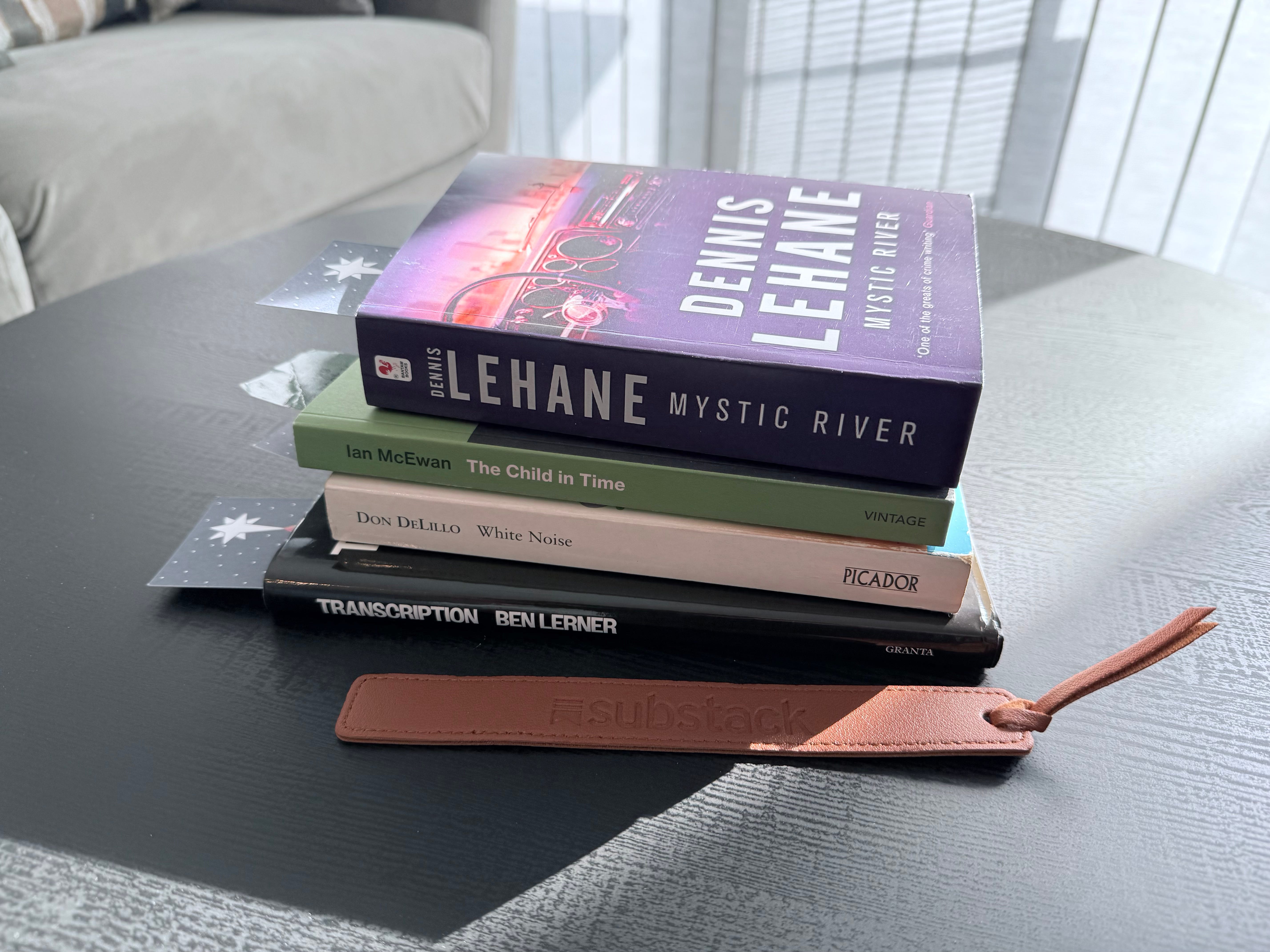
Well, following a recent video where I claimed Don DeLillo’s White Noise is the best postwar American novel, I thought I’d better reread it to check. I first read it more than twenty years ago, when I was a student, much like those the book opens with, with their entire lives stuffed into their parents’ cars on the first day of college.
Reading it again now, I am closer in age to the protagonist, Jack Gladney, and can empathise more keenly with his fears and distractions. The book is just as prescient as I remembered. In fact it looks even more prophetic now. I’m yet to get to the part where DeLillo casually predicts 9/11, but the odd detachment from death in a technocratic world, and the unsettling nature of a state-managed crisis (the ‘Airborne Toxic Event’) feel even more pertinent post-Covid.
It is also every bit as funny as I recalled, with a strangely poetic narrative voice, and so far I feel I was right to put it number one on my postwar American list.
For reasons less clear to me, I have also started rereading Ian McEwan’s The Child in Time. This is a novel we read at school, for A-level English.
I have no idea where my school copy got to, so I’ve had to buy it again. Probably for the best, as we were allowed to take books into exams, and I remember I had a very complex series of notes inside the front and back covers. By the time of the exam I didn’t even need to refer to them, as my famously sharp memory was even sharper in those days. Naturally I got an A, though I always resented my English teacher refusing to predict that I’d get an A, which hampered my chances of getting into top universities. This despite also achieving the third-highest grade in the country on my History syllabus, but let’s not get into that old story again.
I enjoyed the book as a sixth-former, though would have disavowed it by the time I was a university student on grounds of it being ‘middlebrow’. Of course, now I see it is not middlebrow at all, but very impressive writing. I can appreciate the observations on intimate adult relationships, something that school Nick knew nothing about, and the depiction of the political milieu, which I’ve also had a glimpse of now.
McEwan’s meditations on marriage and family life actually have some crossover with DeLillo’s, so it is interesting to be reading both. The Child in Time is also set during a heatwave in London, something else I can painfully relate to at present.
The theme of trauma involving children is something shared by Dennis Lehane’s Mystic River. I have been known to describe crime novels as ‘slop’, though unless you count the hardboiled works of James M. Cain, I have barely read any. After speaking to a working crime writer recently, I decided I should probably rectify my snobbery. The other motivation was my love of the film The Drop, based on Lehane’s short story, ‘Animal Rescue’. The story is frankly excellent, so I thought I’d check out one of his novels.
Lehane is known as a master of story, but there is some striking prose too. I particularly liked:
Sean got that lurching sensation again, this time accompanied by the taste of dirty pennies in his mouth. His stomach felt as if a spoon had hollowed it out.
Lehane is no punk, as a Lehane character might say.
The fourth book I’m reading (yes I know, insane system) is Ben Lerner’s Transcription.
The theme throughout this post has been overcoming various reading prejudices of mine. There’s been ‘Middlebrow’, and crime, and now we can add contemporary novels, which I tend to expect will be terrible. Transcription is from 2026, so about as contemporary as it gets. I kept hearing about it, so decided to give it an honest try.
So far I hate it. I hate the protagonist, and all the other characters, and I suspect I hate the author too. I certainly don’t require ‘likeable’ characters in fiction—Bret Easton Ellis is one of my favourite writers. But where Ellis treats his characters with the appropriate mix of irony, scorn and affection, I suspect Lerner doesn’t know how annoying his cast of somewhat wimpy and self-important intellectuals really are.
But then, as we’ve learned, I could be wrong.
This four-book system is something I am just trying, applying all the usual techniques I shared with everyone in my video on how to read more.
I am not as far on into the Lehane as the others, and in this system you have to go back and catch up if you’re lagging behind on one of the books. It’s a maverick strategy that risks not finishing anything, but my belief is I will finish all four in succession in a blaze of glory.
There is a certain impatience in the rereads when one comes to an action sequence, if such a term can be used for literary fiction. I know what is going to happen in DeLillo’s ‘Airborne Toxic Event’, for instance. But then one is not reading these for plot anyway. If you want that, you can read crime. Which I also am, of course, with Lehane.
Anyway it’s a good thing I have now started this page, so all this counts as work.
Feel free to add your views. As this is a new venture I have made commenting free (speaking of risky strategies).
If you want to get any of the books, you can use the links in this article. I get some tiny amount of money if you do.
Thanks for subscribing to Nick Reads!
Nick
I share your love of White Noise and likewise read it at university. It formed part of what became my focus on the postmodern novel; a term that has been misrepresented as some kind of political movement, when it's more of a descriptive, historical category and/or style (Auster, DeLillo,, Vonnegut, Ballard, Fowles, etc). Call it postwar/late 20th Century, whatever, but it is for me the last great era of the novel.
I also have an odd relationship McEwan. Not sure why. Maybe memories of Guardian interviews as oppose to his work, the earlier part of which is magnificent. I may well go back and re-read.
I've got a Ben Lerner on the pile, but ... contemporary writing always has that inevitable sense of being on the verge of being lectured, and/or having a crowbarred in unlikely worthy female/ethnic minority character (had this in Andrew Miller recently). I don't want to throw another book across the room.
Ordered 2, don’t spend it all at once….