

When I started this page I said I would post the books I’m currently reading. I did one post, then failed to do any more. Classic Nick. I need to be more robotic and ruthless. This is what the algorithm demands.
But I have now remembered to do it again, hence this post.
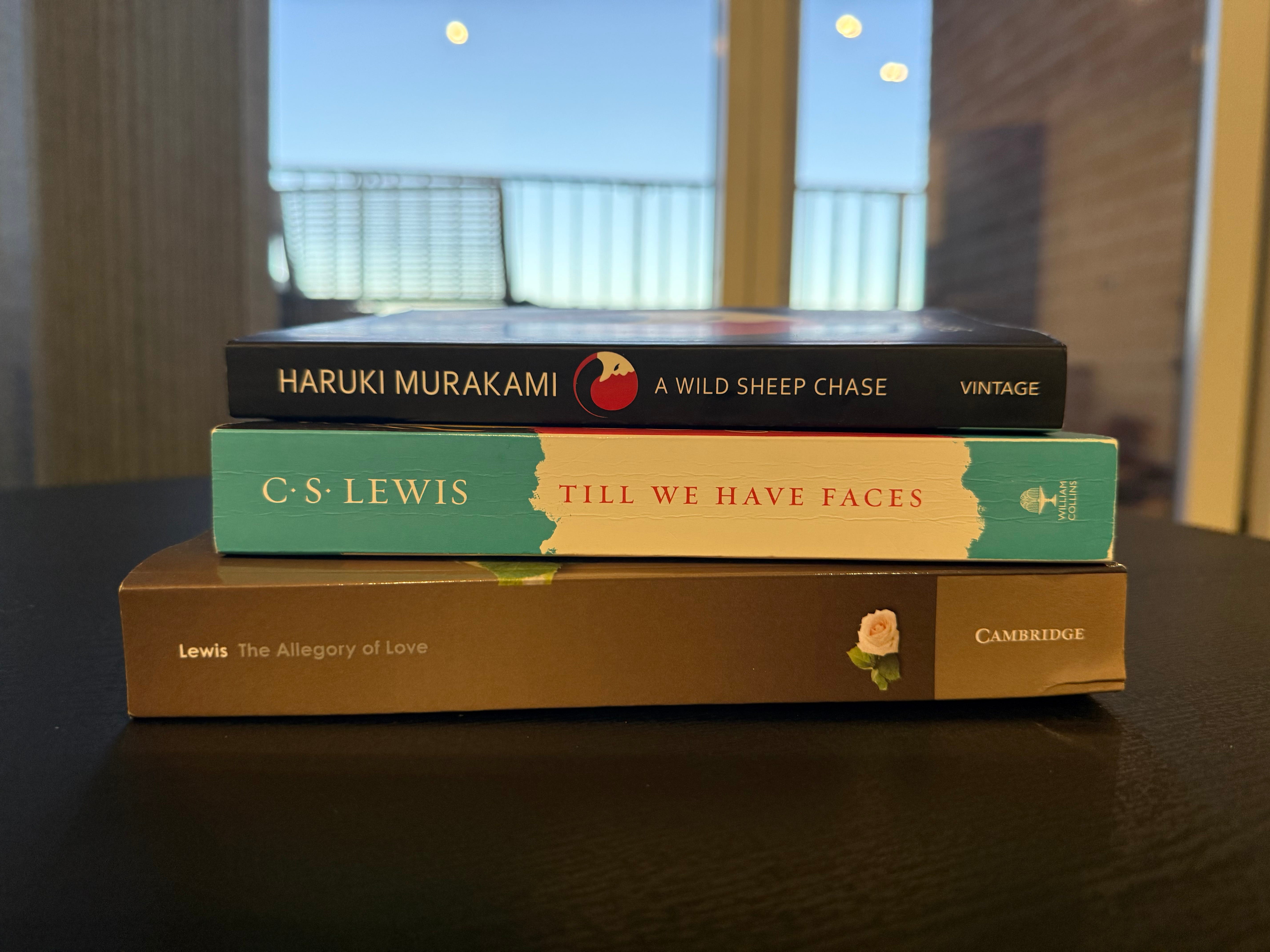
It is a strangely clear and sunny October day in London, though I am at home, ill. However, I have just managed to finish C.S. Lewis’s Till We Have Faces. Lewis felt this was his greatest work. He may well be right, though for now I still prefer the Ransom trilogy.
Till is certainly an extraordinary book. Each page resonates with a kind of dense beauty, though it never becomes a ‘page-turner’. Of course, such vulgarities are not welcome on Nick Reads anyway (though I do confess to becoming slightly more keen on plot with age).
In this way it is perhaps more like, say, Moby Dick. One senses it is a classic, though it never becomes as enjoyable as Perelandra or That Hideous Strength. The unsparing first person narrative in part one (which comprises most of the book) at times almost reminded me of real-life accounts, such as the memoir of Olaudah Equiano.
I note that many readers have said they didn’t like the book at first, and only recognised its greatness over time. I can easily imagine the latter, especially when considering the novel’s final section, which attains an almost divine radiance that is unlike anything else I have come across in literature.
I hope to discuss the book in more detail soon.
After finishing it, I returned to my strange goal of reading every Haruki Murakami novel in order. I have already read three of them not in order, but I have now embarked properly upon this pointless quest, and thus have read his first two, and I’m now onto his third novel, A Wild Sheep Chase.
To make it extra complicated, I read this book many years ago, but I decided to reread it, as the strictures of this stubborn task seemed to dictate.
I didn’t like the book then, and so far I don’t like it now. It is slightly better than his first two books, which Murakami himself considers failures. Bizarrely, he retains the character known as ‘The Rat’ for all three novels, despite this character being entirely uninteresting and underdeveloped.
Still, there are hints of Murakami’s later strengths, most notably the dialogues with quirky women and mysterious villains. But so far, although the prose itself is much lighter than Till We Have Faces, it is much more of a grim struggle to get through, because it simply isn’t very good.
What’s mildly interesting is that it’s bad in a different way to how I remember it being bad last time. If you’ll forgive a clunky sentence.
When I first read it all those years ago, I remember thinking it was a hipster mediocrity. Now that I read it in the light of his other work, I see it as a development from the first two novels, but nothing like as good as his later stuff. In fact, it is like reading a completely different book to when I first read it. Almost as if Murakami has snuck in a totally different story in the meantime. Which is the kind of thing that would happen in a Murakami novel.
Despite me essentially hating these first three books, as I said in my video on his debut Hear the Wind Sing, there is a kind of encouragement to be found in the fact that Murakami got so much better. Norwegian Wood is a vastly superior version of what these early novels try to be. Kafka on the Shore is hugely enjoyable, and The Wind-Up Bird Chronicle touches greatness.
I will continue my mission to read them all in order, with the caveat that I am now reading other books in between, which only occurred because someone asked me to discuss Till We Have Faces on a podcast. But it seems like a good rule, and less needlessly depressing than my original plan.
You will also note I have included a slightly battered copy (just how they arrive these days) of The Allegory of Love. This is C.S. Lewis’s study of of the allegorical treatment of love in the Middle Ages and Renaissance. It is a much bigger book than I thought, and I have foolishly decided to tackle it along with all my other reading. Though I reserve the right to change my mind.
I’m only a few pages in so can’t say too much, except that it’s Lewis, so of course it is incredibly learned and interesting. Though he refuses to translate ancient squiggly languages, in a stark reminder of the decline in education. He must have assumed everyone reading the book would have learnt all these squiggles as a matter of course. Once more, I am filled with loathing for my state school non-education.
Though on a more positive note, apparently Nick Reads is already at number 88 ‘Rising in Literature’ on Substack. I’ve never understood what this means, but I presume it is better than not rising in literature.
Kind regards,
Nick