

Following my last reading update, I finished my reread of Don DeLillo’s White Noise, and made a video on it. I also finished rereading Ian McEwan’s The Child in Time, and then I reread Enduring Love (I read both of these at school, and for some reason wanted to return to them now).
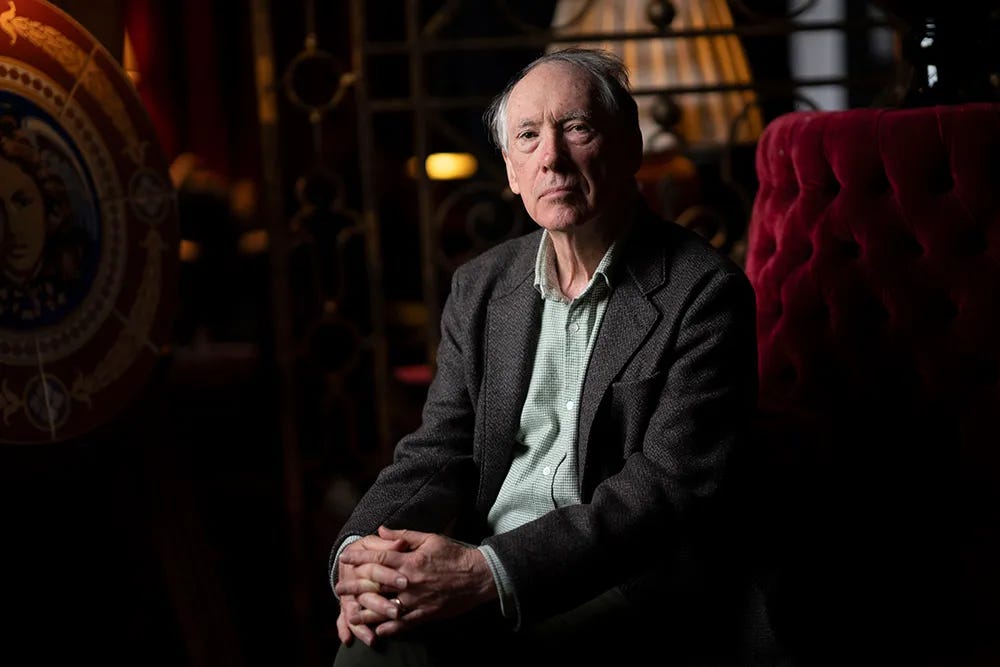
It’s easy to dismiss McEwan as a kind of broadsheet darling. He is a safe choice for just about any literary prize, and in many ways represents a now-collapsing liberal order.
For one, he comes from the time when white male authors ruled, before they were almost completely frozen out of the world of literary fiction. Though as in so many industries, the old guard remained, while the new blood was barred (which is why McEwan is still around and has a massive house).
He also represents the old order in his worldview, which appears to be broadly the school of liberal New Atheism. He was, of course, friends with the late Christopher Hitchens, and at the end of Enduring Love he cites Steven Pinker. One of his novels has been described as a ‘boomer parable’, and McEwan does seem in many ways to be the archetypal liberal boomer.
He has a tendency to show off his reading in the field of science, and one senses a reverence for the sciences that perhaps even, like the protagonist of Enduring Love, extends to mild embarrassment at not being among their number himself.
Then we have the typical McEwan milieu. His characters are invariably poshos who enjoy picnics, drink expensive wines, and complain about expensive problems.
All this would make him too irritating to read, if he didn’t happen to be such a good writer. He is at his best when exploring the complex mesh of affections and resentments between couples, as well as the bonds of family and the mysteries of friendship.
He is also a master of storytelling and suspense. If you find yourself reading a McEwan alongside less tightly plotted fiction, you will end up finishing the McEwan first due to the sheer narrative drag.
However, rereading these books decades later, it is not the plots that stayed with me. Indeed, I had forgotten the ending to The Child in Time and the entire denouement of Enduring Love. What I retained instead were certain scenes and even specific sentences. This may be partly a reflection of my indifference to plot, or the way we remember novels in general, but it is probably also a result of the richness of McEwan’s characters, and the dynamism of his prose.
Enduring Love has some extraordinary set pieces and impressive changes of voice, though The Child in Time remains the superior book by some margin. It is less aggressively plotted, but is more rewarding in all other regards. Its depiction of reserved English parents alone, a relatively minor part of the book, is wonderfully accurate. And the disturbing nature of Charles Darke’s regression to childhood has stayed with me for decades.
There is no accurate gauge for these things, but it seems to me that McEwan is seen as the favoured choice of the highbrow housewife, rather than as a true literary great. To some degree I now think this is unfair, and probably something to do with his being English. To risk a football analogy, it is much like the way that, say, Paul Scholes for years was not recognised as a genius on the level of his European counterparts. McEwan rose to fame in the twentieth century, which, in the literary world, largely belonged to the Americans.
I enjoyed these books as a school student, then went through a long period where I would have pretentiously denounced them, and have finally returned to them more able to fully appreciate their nuances, now that I, like McEwan’s characters, am a flawed adult.
I still don’t have the bank account to appear as a character in a McEwan novel, and if I did I would probably be the irrational antagonist, questioning the boomer wisdom of the hero and his materialist outlook. So I’ll just have to stick to reading them with much appreciation and only occasional moments of mild disapproval.
On his ‘tendency to show off his reading in the field of science’, his fellow UEA alumnus Kazuo Ishiguro could be a good contrast for you to cover in the future – I remember hearing Ishiguro say that he does no research, just writes, and then checks at the end if he got anything wrong that has to be changed. McEwan is a master storyteller, as you say Nick, but for me Ishiguro is better at making each of his books feel like a unique world with its own atmosphere and feeling tone.
I've only read McEwan's earlier stuff, The Company of Strangers was on the syllabus of my bachelor degree many years ago, and it made a strong impression on me, a brilliant novel/novella. I should really catch up with some of his later works, we have a couple knocking around the house somewhere.